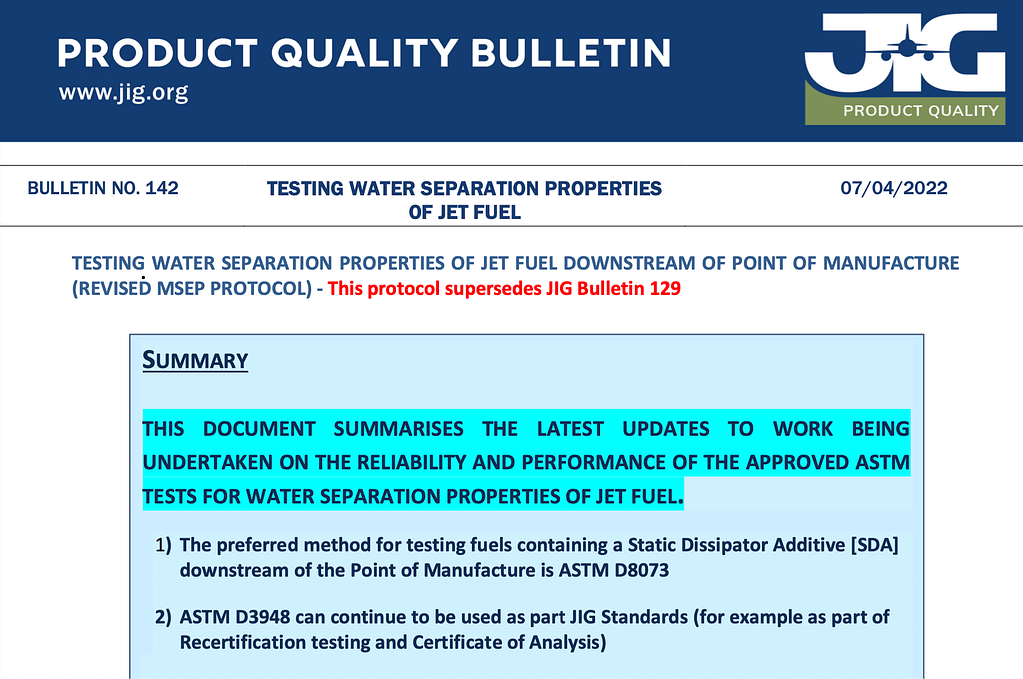
Joint Inspection Group (JIG) has released a new bulletin no. 142 regarding ASTM D8073…
1) Preferred method for testing fuels containing a Static Dissipator Additive [SDA] downstream Point of Manufacture is ASTM D8073
2) ASTM D3948 can continue to be used as part JIG Standards. For example, as part of Recertification testing and Certificate of Analysis.
Full JIG Bulletin 142 Report here: Bulletin-142-Testing-Water-Separation-Properties-of-Jet-fuel-Revised-MSEP-Protocol-04_2022
Standard Test Method for Determination of Water Separation Characteristics of Aviation Turbine Fuel by Small Scale Water Separation Instrument ASTM D8073: https://store.astm.org/d8073-22.html
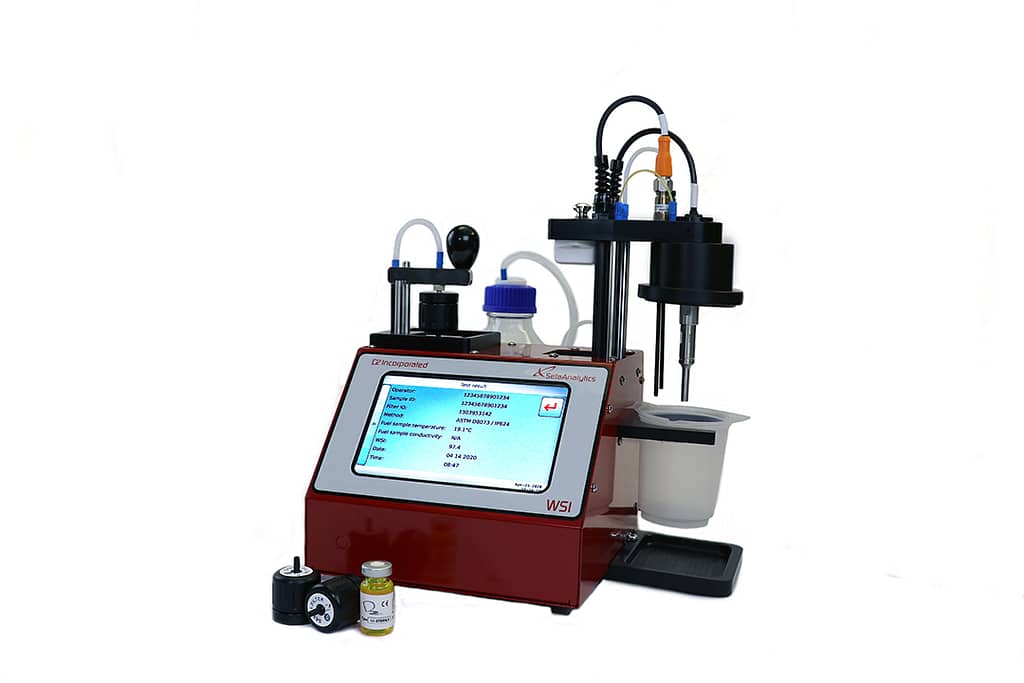
REVISED JIG PROTOCOL FOR ASTM D8073 WATER SEPARATION TESTING DOWNSTREAM OF POINT OF MANUFACTURE EFFECTIVE APRIL 2022
Where you conduct water separation performance testing downstream of the point of manufacture. Facilities operating to the JIG Standards, the following protocols shall apply.
We should do testing using either…
ASTM D7224 with a minimum limit of 85, or
ASTM D8073 (IP624) with a minimum limit of 88.
Note that for fuels containing an SDA, the preferred method is ASTM D8073, and JIG does not recommend ASTM D7224.
Despite the uncertainty with some fuels, as explained above. These methods are the preferred methods for testing downstream of the point of manufacture. As they have improved precision relative to MSEP (ASTM D3948).
Alternatively, conduct testing using ASTM D3948. JIG still intends to withdraw this method in the future.
1. If the results are between 60 and 70, run a confirmation test of the original sample. Provided it provided the two test results within the repeatability of the ASTM D3948 method. Enter the average MSEP result from the two tests onto the test certificate. Subject to all other properties meeting specification requirements, issue the certificate. They may release the batch without recourse to other fuel suppliers involved at a location concerned, subject to local procedures. The local Re-certifying authority shall endorse the certificate. “MSEP result within precision limits of the test method”. Advise all fuel suppliers at the location should of this occurrence retrospectively.
2. If the result of ASTM D3948 testing is less than 60. We shall run a test on the original sample using either ASTM D7224 or ASTM D8073 (IP624). If the result of the test is greater than 85 for ASTM D7224 or 88 for ASTM D8073 (IP624). We shall enter this result into the test certificate. Subject to all other properties meeting specification requirements. We can issue the certificate. They may release the Batch without recourse to other fuel suppliers involved at location concerned, subject to local procedures.
3. If the initial result for ASTM D7224 or ASTM D8073 (IP624) is below the stated minimum limit. They show these tests under item 1 or 2b above. Follow the protocols detailed in EI/JIG 1530 Annex E. To establish the result before quarantining the fuel pending an investigation to determine the source of the failure.
Protocols Continued…
4. A useful part of the investigation should be to carry out a test of the same sample. The other test method listed in 1 above before quarantining the fuel. Results for a sample which has a “pass” result for one method. But report a “fail” result by the other to the JIG Product Quality Committee.
5. Unable to identify the source of failure after investigation. Remediation actions such as, but not limited to, clay treating or dilution may achieve the required minima for ASTM D7224 or ASTM D8073 (IP624). (Note that clay treatment and/or dilution may cause loss of electrical conductivity in the fuel batch. Which may need subsequent correction by redosing the SDA.)
6. Where remediation is not workable, we shall downgrade the product.
Throughout transfers of fuel associated with batches released under this protocol. Take special care to ensure complete water draining under the operating standards in effect. Either JIG 1/2 or EI/JIG 1530. To further ensure that the fuel is free of excess water and dirt when delivered into aircraft.
Local Endorsement by Local Fuel Suppliers
Subject to the endorsement of all fuel suppliers at a specific location. We shall advise the above protocol to their recertification laboratory(s) for automatic implementation. However, ensuring the integrity of Jet Fuel is at all times the paramount consideration. We shall deem nothing in this protocol to override this principle. Fuel suppliers keep the right, in the absence of positive evidence of an investigation. Any subsequent suitable corrective/preventative action. To ultimately withdraw their support for the use of this protocol.
Although it remains permissible, it is the intention of JIG. At some future date, to withdraw use of ASTM D3948 as a product quality control method downstream of refineries. This withdrawal will publish and be the subject of a future bulletin in due course.